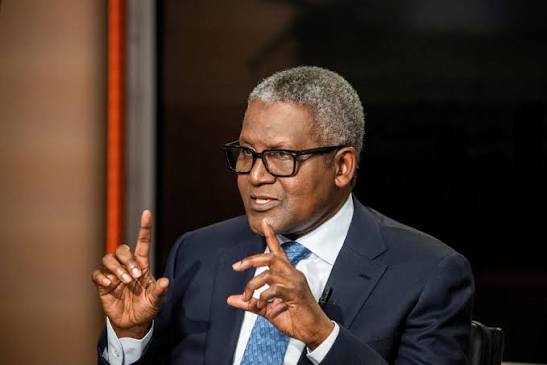
Early life and family background.
Aliko Dangote was born on April 10, 1957, in Kano, northern Nigeria. He turned 69 in April 2026.
He grew up in a wealthy Muslim trading family.
His parents were Mohammed Dangote and Mariya Sanusi Dantata, and his maternal family belonged to the prominent Dantata business dynasty.
This background exposed him to commerce from an early age.
In a 2014 interview with TIME, Dangote explained that he was raised by his grandfather.
He described an upbringing that gave him confidence and connected his interest in business to his family’s trading background.
His later success therefore developed from both an entrepreneurial environment and his own expansion into large-scale industry.
Education.
Dangote studied at Al-Azhar University in Cairo, Egypt.
His official corporate biography identifies him as a graduate of the university, while Dangote Cement’s 2024 annual report describes his field of study as Business Studies.
He has also received honorary doctorates from several universities, including Coventry University in the United Kingdom, the University of Ibadan and Ahmadu Bello University in Nigeria.
These honorary awards are separate from his university qualification.
How he started his business career.
Dangote began his commercial career in the late 1970s.
According to Dangote Industries’ official biography, he started trading rice, sugar and cement in 1978 before moving into manufacturing.
His early business involved supplying essential commodities with regular demand among households, traders, and construction businesses.
Trading gave him experience in purchasing, distribution and the supply of goods.
These activities provided the foundation for the industrial businesses he developed in later years.
Building the Dangote Group.
Dangote gradually expanded beyond buying and selling commodities to producing them. This transition became a defining feature of his business career.
Dangote Group developed interests across sectors including cement, sugar, salt, packaging, energy, fertiliser and petrochemicals.
Its businesses reflect a focus on products used in construction, food preparation, agriculture and transport.
The move into manufacturing required factories, machinery, dependable power, transport networks and substantial financing.
It also changed the nature of his business: instead of earning income mainly through trading, the group could participate in production and distribution.
In his interview, Dangote described expanding into related activities, including packaging for the products his companies supplied.
He also identified reliable electricity and access to capital as important factors in building industrial businesses.
His role in the cement industry.
Cement became one of the best-known parts of Dangote’s business empire.
Through Dangote Cement, his industrial activities expanded beyond Nigeria into other African markets.
The business helped establish his reputation as a major African manufacturer.
Cement is central to housing, roads and other infrastructure, giving the company a role in a sector closely connected to economic development.
Dangote stepped down as chairman of Dangote Cement in July 2025.
Emmanuel Ikazoboh succeeded him, with the leadership change allowing Dangote to concentrate more closely on the wider group’s refinery, petrochemical and fertiliser businesses.
His departure from the chairmanship did not change his historical role as the company’s founder.
Investment in fertiliser production.
Dangote’s expansion into fertiliser manufacturing connected his industrial interests more directly to agriculture.
In March 2022, he opened a $2.5 billion fertiliser plant in Nigeria with an annual production capacity of three million tonnes.
Reuters reported that the facility was intended to serve African and international markets.
Fertiliser production supports the supply of agricultural inputs used by farmers.
It also provides an export opportunity, extending the group’s activities beyond construction materials and consumer goods.
In August 2025, Ethiopia announced an agreement with Dangote Group for a separate $2.5 billion fertiliser project.
The proposed plant was designed to produce three million metric tonnes annually. That announcement concerned a planned development, rather than a completed operating facility.
Development of Dangote Refinery.
Dangote Petroleum Refinery is among the most ambitious projects of his career.
Located in the Lekki area of Lagos, it was developed to process crude oil into fuels needed by Nigeria and other markets.
The refinery was inaugurated in May 2023 and began producing diesel and aviation fuel in January 2024.
Reuters reported a construction cost of approximately $20 billion. Petrol production followed in September 2024.
The plant’s original processing capacity was 650,000 barrels of crude daily.
In June 2026, the company announced that it had achieved 700,000 barrels per day during a performance test conducted by its process licensors.
That test represented a technical milestone, although processing achieved during a test should not be treated as a guaranteed daily operating average.
The refinery also brought challenges. By August 2026, access to crude at commercially workable prices remained an important issue for domestic refiners.
Reuters reported that Nigeria was considering changes to crude allocation and pricing rules to improve supplies.
Philanthropy and the Aliko Dangote Foundation.
Dangote’s charitable activities are organised largely through the Aliko Dangote Foundation, which was incorporated in 1994 as Dangote Foundation.
Its work focuses on health, education, economic empowerment and support for vulnerable communities. Childhood nutrition and humanitarian assistance are also among its priorities.
The Education Outcomes Fund’s profile of Dangote records that he made an initial endowment of $1.25 billion to the foundation in March 2014, supporting the expansion of its activities.
His philanthropy has included partnerships aimed at improving public health and access to education. These activities form a significant part of his public profile alongside his commercial investments.
Family and personal life.
Dangote generally attracts more public attention for his businesses than his private life.
His three daughters, Halima, Mariya and Fatima have also become associated with the family’s business activities.
Reporting published before August 2026 described their involvement in key operations across the group. Their participation has brought attention to the development of another generation of leadership within the family business.
Honours and international recognition.
Dangote holds the Nigerian national honour of Grand Commander of the Order of the Niger, commonly abbreviated as GCON.
His official biography also records international appointments, including his selection as co-chair of the US-Africa Business Center in September 2016 and his appointment to the board of the Clinton Health Access Initiative in April 2017.
These roles reflect recognition extending beyond his companies into business cooperation, healthcare and development.
Business influence and legacy.
Aliko Dangote’s career illustrates the growth of a trading enterprise into a group with substantial manufacturing investments.
His businesses have placed him at the centre of discussions about African industrialisation, domestic production and dependence on imports.
His influence has also attracted scrutiny.
Reporting has examined concerns about competition, market concentration and the relationship between major industrial businesses and government policy.
A balanced account of his career therefore includes both his investment achievements and the debate surrounding his economic influence.
As of August 26, 2026, Dangote’s business story remained closely tied to the performance of his established companies and newer industrial projects.
From commodity trading to cement, fertiliser and refining, his career demonstrates the scale of private investment possible in Africa and the operational challenges involved in sustaining it.
Conversation
0 publishedJoin the discussion with a NewsRoomUpdate account. Comments are reviewed to keep the conversation constructive. Sign in to comment