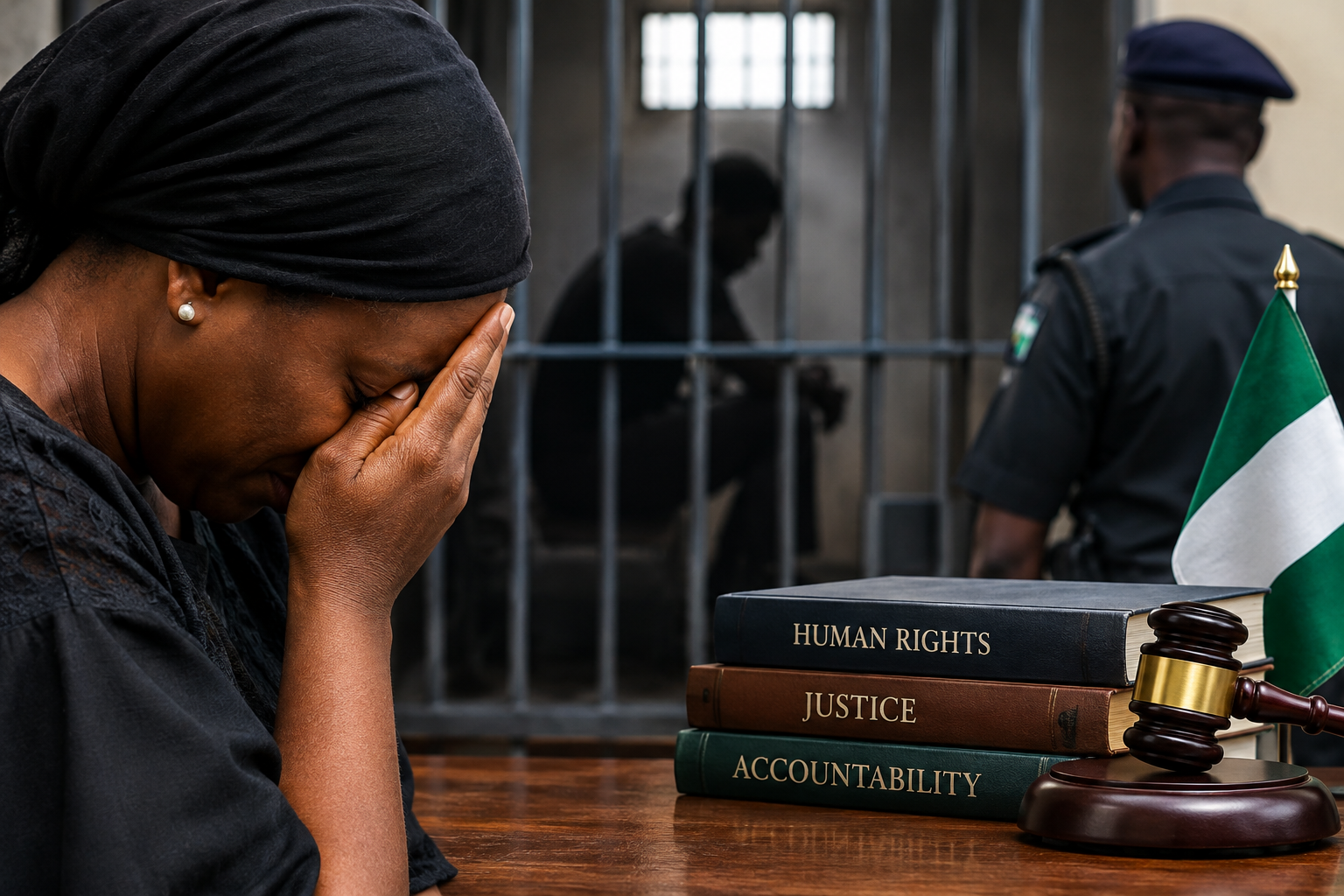
A young Nigerian man leaves his home, preparing to face another day of work. Before stepping outside, he reassures his wife and children that he will return later in the evening. Nothing about the morning suggests that it could become the beginning of a tragedy.
But hours later, his plans are interrupted when he is arrested during a security operation over a suspected offence and taken into custody.
At home, his family waits.
At first, they assume he has been delayed. As the hours pass without a phone call or a familiar knock at the door, anxiety begins to replace hope. They wonder where he is, why he has not returned and whether something has gone wrong.
Then comes the news they never expected: their loved one has died while in detention.
In a moment, an ordinary family is plunged into grief. But alongside the pain of losing someone they love comes another burden — the search for answers.
What happened behind the walls of the detention facility? Was he given medical attention if he needed it? Was he treated humanely? Could his death have been prevented? And, perhaps most importantly, will anyone be held accountable?
This is an illustrative story, not an account of a specific incident. Yet it captures the difficult questions that can confront families when someone dies in the custody of security agencies.
For those left behind, the tragedy does not end with the death itself. It continues through uncertainty, unanswered questions and the struggle to understand what happened.
AN ARREST DOES NOT MEAN A PERSON IS GUILTY
One of the most important principles of justice is that a person accused of an offence must not be treated as though guilt has already been established.
In Nigeria, the law recognises fundamental rights that apply to individuals regardless of whether they are free citizens, criminal suspects or people awaiting trial.
The 1999 Constitution of the Federal Republic of Nigeria, as amended, protects the right to life and the dignity of the human person. It also provides safeguards relating to personal liberty and fair hearing.
These protections matter because an arrest is not a declaration of guilt. It is a step in a legal process through which allegations must be investigated and, where appropriate, tested before a court.
Security agencies have a responsibility to carry out their duties within the law while ensuring that people in their custody are treated humanely.
A suspect may be questioned, investigated and prosecuted where the evidence supports it. However, detention must not become an opportunity for abuse, neglect or punishment outside the law.
Every person in custody remains entitled to lawful treatment and protection from avoidable harm.
The principle is straightforward: the responsibility to enforce the law does not remove the responsibility to respect it.
BEHIND DETENTION WALLS: WHEN CONDITIONS BECOME A CONCERN
For someone who has never experienced detention, it may be difficult to imagine what life is like behind the walls of a holding facility.
Yet the conditions in which detainees are kept can have serious consequences for their health, safety and dignity.
Overcrowding, poor ventilation, inadequate sanitation and limited access to healthcare are among the concerns that can threaten the well-being of people held in detention.
When many people are confined in spaces that are not designed to accommodate them, the risks of illness and other health complications may increase. Where medical attention is delayed or unavailable, a condition that might otherwise be treatable can become more serious.
These concerns make proper supervision and regular inspections essential.
Detention facilities need clear procedures for recording arrests, monitoring the condition of detainees, responding to medical emergencies and ensuring that officers understand their responsibilities.
Training is also important. Officers must be equipped to manage people in custody professionally, recognise emergencies and respond appropriately when a detainee's health deteriorates.
The issue goes beyond the physical condition of a detention centre. It is also about the values and standards that guide the people responsible for those held inside it.
A person's freedom may be restricted under lawful circumstances, but their humanity does not disappear at the moment of arrest.
WHEN A DETAINEE DIES, THE QUESTIONS MUST NOT BE IGNORED
For a grieving family, receiving news of a loved one's death may be only the beginning of a painful search for the truth.
They may want to know when the person became ill, whether medical assistance was requested, who was responsible for supervising the detainee and what happened during the final hours before the death.
These questions deserve serious attention.
Whenever a person dies in the custody of a security agency, the circumstances should be examined through a thorough, impartial and transparent investigation appropriate to the case.
Medical records, detention registers, witness accounts and other relevant evidence may help investigators establish what happened. The actions of officers responsible for the detainee's care and supervision may also require examination.
Where necessary, independent medical assessments and forensic evidence can help clarify the cause and circumstances of death.
The objective should not be to protect an institution's reputation or rush to blame an individual before the facts are established. It should be to determine the truth.
If an investigation reveals negligence, abuse or other unlawful conduct, the findings should lead to appropriate legal or disciplinary action in accordance with the law.
Where wrongdoing is not established, the evidence should still be explained clearly enough to address legitimate questions.
Accountability requires more than issuing a statement or announcing that an investigation has begun. It requires a credible process, careful examination of the evidence and appropriate consequences where responsibility is established.
For families already struggling with grief, access to reliable information can be an important part of seeking justice.
THE HUMAN COST OF UNANSWERED QUESTIONS
When a person dies in custody, the consequences extend beyond the detention facility.
A family may lose its main source of income. Children may grow up without a parent. A spouse may be left to manage household responsibilities alone. Parents may spend years wondering whether their child could have been saved.
The emotional consequences can be especially painful when the family believes that the circumstances of the death have not been properly explained.
Without credible information, rumours can spread, suspicion can deepen and public confidence in law enforcement institutions can suffer.
This is why communication with affected families matters. They should be treated with dignity, provided with information they are legally entitled to receive and given access to appropriate complaint and investigative procedures.
The public also has a legitimate interest in knowing whether institutions entrusted with enforcing the law are meeting their legal obligations.
Transparency does not mean assuming every allegation is true. It means ensuring that serious concerns are examined fairly and that the conclusions are supported by evidence.
Justice requires both accountability and fairness — for the deceased, for the family and for anyone accused of wrongdoing.
BUILDING A JUSTICE SYSTEM THAT PROTECTS EVERYONE
Preventing deaths in custody requires more than reacting after a tragedy has occurred. It requires systems designed to reduce risks before lives are lost.
Improved detention facilities, adequate medical services, reliable record-keeping and regular independent oversight can help identify problems before they lead to irreversible consequences.
Clear procedures for handling medical emergencies are equally important. Officers must know when to seek medical assistance, how to document incidents and whom to notify when a detainee's condition becomes critical.
Effective complaint mechanisms can also help people report mistreatment and enable authorities to investigate concerns before they escalate.
Beyond these practical measures, there must be a willingness to hold institutions and individuals accountable when evidence establishes that they have failed in their duties.
Reforms are most meaningful when they produce measurable improvements in the way detainees are treated and when investigations into deaths are conducted without improper interference.
None of this weakens law enforcement. On the contrary, a system that respects the law and protects human dignity is better positioned to earn public trust.
The fight against crime and the protection of human rights are not opposing goals. A society can demand effective policing while insisting that every person in custody be treated lawfully.
JUSTICE MUST NOT END AT THE DETENTION GATE
Return to the family waiting at home.
The young man's wife still needs answers. His children still need their father. His relatives still want to understand how a routine day ended in a devastating loss.
No investigation can erase their grief. But a credible investigation can help establish the truth, identify failures and prevent similar tragedies from happening to other families.
That is why deaths in custody must never be treated as matters that concern only the deceased, their relatives or the institution involved.
They raise fundamental questions about the meaning of justice, the limits of state power and the responsibility that comes with taking another person's liberty away.
A society's commitment to human rights is measured not only by how it treats those who are free, but also by how it treats those who cannot leave.
Every person taken into lawful custody deserves humane treatment. Every suspicious or unexplained death deserves appropriate scrutiny. And whenever evidence establishes wrongdoing, accountability must follow.



Conversation
0 publishedJoin the discussion with a NewsRoomUpdate account. Comments are reviewed to keep the conversation constructive. Sign in to comment