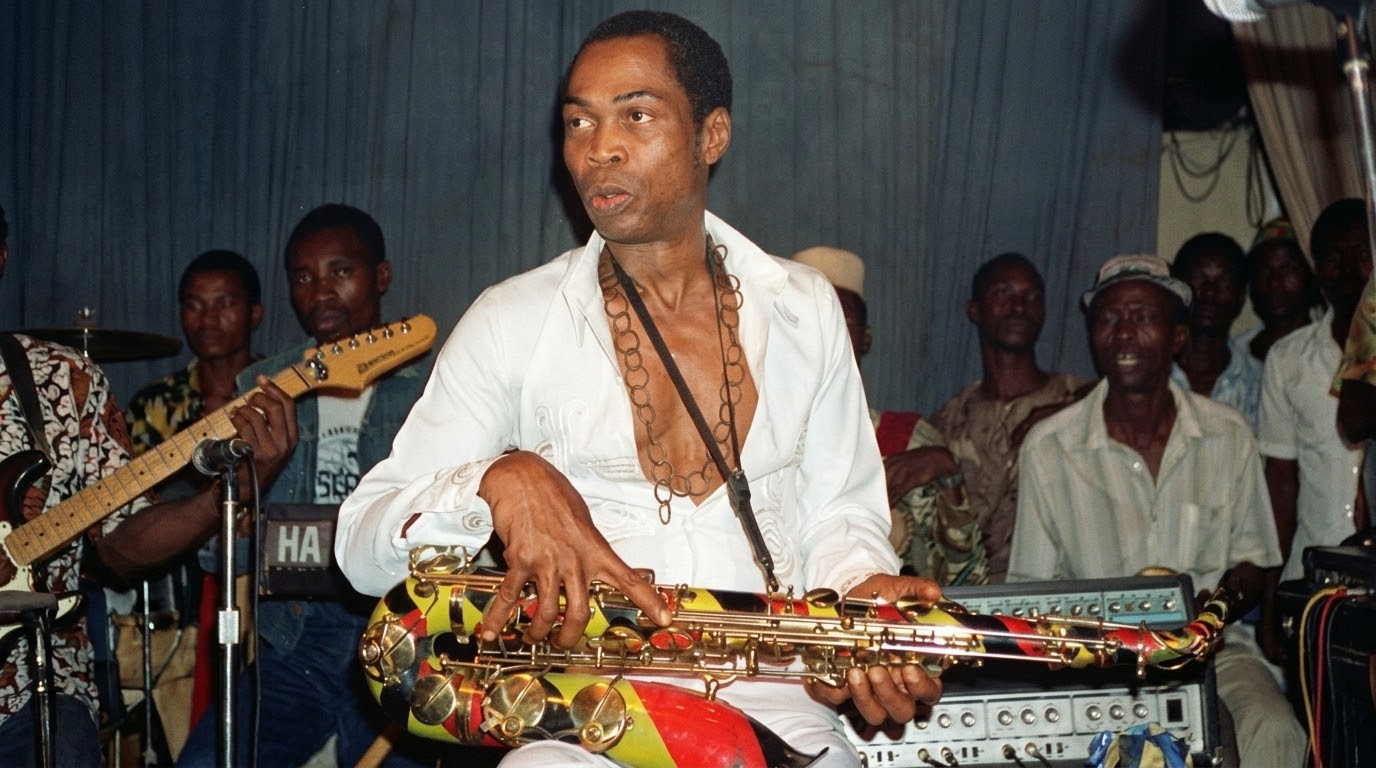
Fela Anikulapo-Kuti was more than a musician. He was a composer, bandleader, political activist and cultural revolutionary whose music challenged authority and gave a voice to people who felt ignored by those in power.
Born Olufela Olusegun Oludotun Ransome-Kuti on October 15, 1938, in Abeokuta, Ogun State, Fela grew up in a family known for its involvement in education, music and political activism. His mother, Funmilayo Ransome-Kuti, was a prominent women’s rights campaigner and nationalist, while his father was a clergyman and educator.
Although his family initially expected him to pursue medicine, Fela chose music. He travelled to London in 1958 to study at the Trinity College of Music, where he developed his skills in composition and trumpet performance.
During his time in London, he formed a band and began experimenting with different musical styles. After returning to Nigeria, he continued exploring a sound that combined highlife, jazz, funk, soul and traditional West African rhythms.
These experiments eventually developed into Afrobeat, a distinctive musical style that became closely associated with his name.
Fela’s music was not created simply for entertainment. He used long instrumental arrangements, powerful vocals and politically charged lyrics to address corruption, military oppression, poverty and social inequality.
Songs such as Zombie, Water No Get Enemy, Sorrow, Tears and Blood, Shuffering and Shmiling and Expensive Shit became important parts of his musical catalogue.
His criticism of Nigerian authorities frequently brought him into conflict with successive governments. His home and communal space, known as Kalakuta Republic, became a symbol of his independence and resistance.
In 1977, soldiers attacked and destroyed the Kalakuta Republic. Fela was severely assaulted, and his mother, Funmilayo Ransome-Kuti, later died from injuries associated with the attack.
Rather than abandon his political message, Fela continued using his music to challenge injustice. He also established the Afrika Shrine in Lagos, which became an important centre for live performances and cultural expression.
His influence extended beyond Nigeria, attracting international audiences and musicians interested in his distinctive fusion of African rhythms, jazz and funk.
Fela died on August 2, 1997, in Lagos, but his influence did not end with his death. His sons, Femi Kuti and Seun Kuti, continued his musical tradition, while several generations of African musicians have drawn inspiration from his sound and fearless approach to artistic expression.
His legacy has also received growing international recognition. In 2026, he became the first African artist to receive the Grammy Lifetime Achievement Award. The same year, he was inducted into the Rock & Roll Hall of Fame in the Musical Influence category.
These honours recognise the lasting impact of his work on music and culture around the world.
Today, Fela remains a powerful symbol of artistic freedom and African cultural identity. His music continues to reach new audiences, while his message about leadership, accountability and social justice remains relevant decades after his passing.
For Nigeria, Fela Anikulapo-Kuti is not simply a legendary musician. He is one of the country’s most influential cultural figures, whose contribution to global music continues to inspire artists far beyond his generation.



Conversation
0 publishedJoin the discussion with a NewsRoomUpdate account. Comments are reviewed to keep the conversation constructive. Sign in to comment